You have already arrived
Jonathan Livingston Seagull“You have already arrived” is Chiang’s instruction that Jonathan must know his destination as already attained before he can fly there at the speed of thought. The expression marks a decisive shift from flight as a learned physical skill to flight as recognition of an unlimited nature; its implications reach beyond teleportation to Jonathan’s understanding of perfection, freedom, and teaching.
Meaning and Instruction
Chiang presents the principle when Jonathan asks to learn this form of flight. Rather than offering a maneuver, he tells Jonathan that thought-speed travel begins with knowing he has already arrived. The instruction reverses the ordinary sequence of departure, travel, and arrival: the destination is not reached by crossing space but apprehended through a change in understanding.
That change requires Jonathan to stop identifying himself as a body restricted to a forty-two-inch wingspan and measurable performance. Chiang teaches that Jonathan’s true nature is perfect and exists everywhere across space and time. The maxim is therefore not simply a claim that travel can be instantaneous; it gives the conceptual basis for loosening the limits Jonathan has assumed to be inherent in himself.
Practice and Realization
The principle proves difficult to apply. Jonathan practices intensely from before sunrise until after midnight, yet at first he does not move even a feather-width. Chiang rejects faith as a substitute for comprehension: Jonathan had learned ordinary flight by understanding it, and must approach this new capacity in the same way.
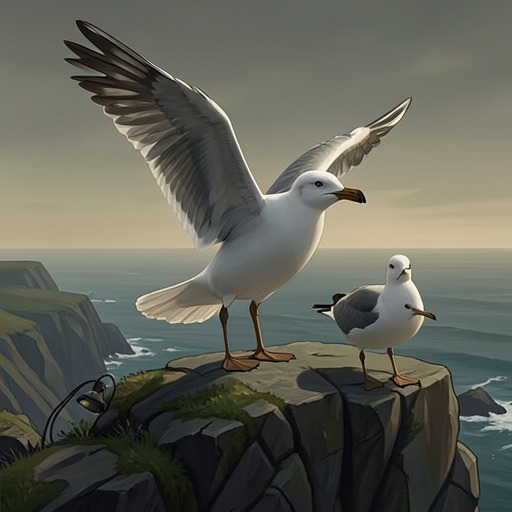
One day, standing on a shore with his eyes closed, Jonathan grasps Chiang’s teaching and recognizes himself as a perfect, unlimited gull. In that instant he opens his eyes on a different seashore, beneath a green sky and twin yellow suns. The arrival makes the maxim concrete, while Chiang’s immediate reminder that Jonathan’s control still needs work distinguishes understanding the principle from mastering its use.
Perfection, Freedom, and Learning
The expression belongs to a broader account of perfection. Chiang explains that heaven is not a place or a time but being perfect, and that perfect speed is being there rather than attaining any numerical velocity. “You have already arrived” gives that idea a practical form: the obstacle is not distance alone, but the belief that the self is confined to a limited body and location.
The maxim also connects Jonathan’s first passion for flight with his later teaching. He had already pursued flight as something more than a way to reach food, enduring repeated high-speed failures and refining his control of his wings. Thought-speed flight extends that pattern of learning beyond physical technique. Chiang then identifies kindness and love as the next, more difficult stage of Jonathan’s education.
Return and Transmission
After Chiang disappears, Jonathan repeatedly thinks of Earth and wonders whether another gull there is struggling against limits or has been made an outcast for challenging the Flock. His desire to return grows alongside his practice of kindness and his effort to understand love. The earlier lesson makes that return intelligible: if space and time do not define his true nature, distance from Earth need not prevent renewed contact or service.
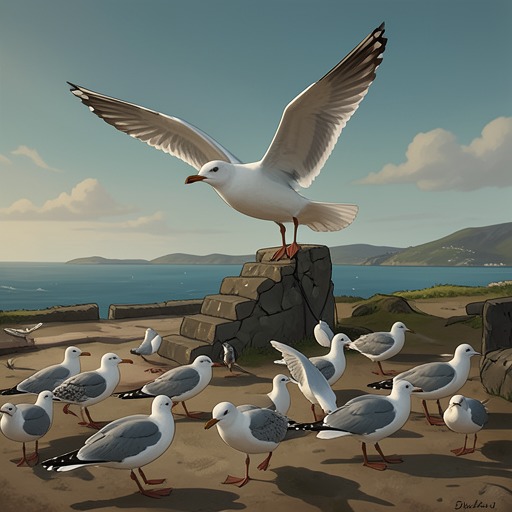
Jonathan accordingly holds in thought an image of gull-flocks on a shore in another time and recognizes himself not as bone and feather but as an idea of freedom and flight, limited by nothing. The maxim thus serves both as a principle of movement and as a hinge in his development: what begins as Chiang’s lesson in reaching another place becomes part of Jonathan’s readiness to carry what he has learned back to Earth and offer it to another gull.